The Great Disaster
Earth AbidesThe Great Disaster is the pandemic that devastates human populations and brings the pre-disaster order to an end. Its origins remain unknown, and its reach exceeds the capacity of public institutions to report or contain it. The catastrophe does not end with the initial wave of deaths: Ish later understands that the loss of civilization leaves survivors exposed to risks once held in check by public health, infrastructure, and collective organization.
Reports of a New Disease
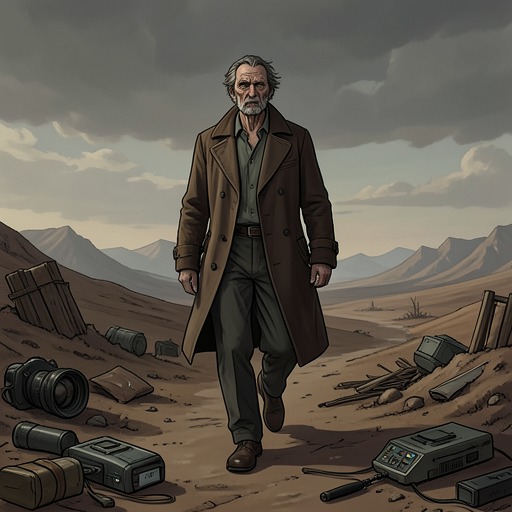
Ish first learns the scale of the crisis from newspaper headlines. The paper, already a week old, describes a disease spreading across the United States with unprecedented speed and fatality. Estimates for several cities suggest that between 25 and 35 percent of their populations have died, though the figures are acknowledged to be little more than guesses. There are no reports from Boston, Atlanta, or New Orleans; the absence of news suggests that the services which would have carried it have already failed. The newspaper gives Ish fragments rather than a coherent national picture, and the gaps in its coverage become part of the evidence: the catastrophe is overwhelming not only its victims but also the systems meant to observe and describe it.
The illness is compared in its symptoms to a kind of super-measles, but neither its cause nor its means of origin is established. A bacteriologist interviewed in the paper says that the emergence of a new disease had long been considered possible. He offers several explanations, not conclusions: the disease might have come from an animal reservoir, arisen through mutation in a microorganism such as a virus, or escaped from a bacteriological-warfare laboratory. The last possibility is described as the popular theory, not a proven account. The disease is believed to travel through the air, perhaps on dust particles, while isolating individuals appears to offer no protection. Those uncertainties leave Ish, and the reader, without a reassuring explanation or a dependable method of defense.
Survival and the Unfinished Catastrophe
Ish encounters the pandemic not only as news. After being bitten by a rattlesnake, he falls ill and later wakes to find that both the local soreness and the other illness have eased. He considers whether he had contracted the new disease and whether it had somehow counteracted the snake venom. This is his simplest explanation for remaining alive, but the account does not establish it as fact. His survival therefore sharpens the mystery rather than resolving it: the same period that has killed vast numbers has left him alive, without telling him why.
The disaster also complicates any simple account of society’s final hours. The newspaper reports that many people escaped from cities, while those who remained had not, as far as Ish can tell from the limited reports, descended into disgraceful panic. He understands the human race as having gone down while still attempting to face the crisis. Yet the apparent courage of those who confronted the disease could not preserve the institutions on which ordinary life depended. Ish eventually names the event the Great Disaster, while recognizing that it had not been complete: some people survived, but survival did not mean that the protections of the old world survived with them.
Secondary Risks and Later Epidemics
Ish’s later reflections give the catastrophe a second phase. He calls the dangers that follow it Secondary Kill: survivors spared by the initial disaster may die from troubles that civilization had previously prevented, treated, or contained. The phrase shifts attention from the sudden pandemic to the exposed conditions that follow mass death. His concern is not that every survivor is doomed, but that losing organized systems changes what survival requires and what threats a community can withstand.
The later outbreaks in The Tribe show why he makes that distinction. When wanderers arrive at the home Ish shares with Em, they have seen smoke on San Lupo Drive; most appear deeply disoriented, like people separated from the social world that once gave their lives structure. These visits are not themselves proof of a disease, but they show how isolation and the loss of a settled community shape the lives of survivors. In a later epidemic, babies begin crying before members of The Tribe develop sore throats, running noses, headaches, and swollen eyes. George and Maurine interpret the relative scarcity of diseases after the Great Disaster as a sign that God had exhausted his anger in one vast plague and removed lesser afflictions as compensation.
Ish offers a different explanation. Because so many people died, he reasons, the transmission chains of many infections were broken; some diseases may have disappeared when the bacteria that caused them became extinct. He distinguishes those infections from illnesses arising through bodily deterioration and from infections carried by animals or ticks. He also recognizes that an individual survivor with a chronic infection might pass it on. In the outbreak that follows a visitor’s stay, the old man had repeatedly blown his nose; Ish infers that an infected sinus may have spread what had once been called the common cold, a disease so rarely encountered that it had seemed extinct. The episode makes a former rarity newly consequential, illustrating how a smaller, local chain of transmission can endanger a community that has no public-health system to interrupt it.
Years later, an epidemic strikes the community with much greater force. After Dick, Bob’s companion on an expedition, falls ill, Ezra and five children are also stricken. Ish believes the outbreak is typhoid. The community knows that Charlie, whose personal habits are described as unclean, had eaten with the two boys for more than a week; Ish also sees the poorly constructed outhouses and flies as an evident possible route of wider infection. The available evidence points to risks in shared food and sanitation, but does not establish a single confirmed chain of transmission. As more people fall ill, fear draws closer even before anyone has died: the community has no way to know who will pass the fever’s crisis. The epidemic makes the costs of lost infrastructure immediate, and it is followed by the deaths and grief that reshape Ish’s confidence in what the community can accomplish.
Civilization Lost and Reconsidered
For Ish, the Great Disaster also marks the disappearance of political protection. In later life, he remembers the years after it as both pleasant and anarchic: people had managed from day to day, but no strong force guaranteed individual safety. Before the collapse, the United States had surrounded ordinary life so completely that he had treated its taxes and regulations as burdens. Only after it vanished did he understand the state as a collective protection, and realize that his small circle of companions had lacked a durable bond capable of standing in for it. The contrast is not simply between freedom and regulation; it is between confidence supported by a functioning society and vulnerability once that society is gone.
The catastrophe also changes meaning across the novel. Ish sometimes considers its paradoxical benefit: mass death may have broken the chains of many infections and allowed later generations to escape some diseases accumulated over centuries. He imagines that in earlier isolated populations, parasites could have been as characteristic of a culture as its tools, and that infectious agents may have contributed to the disappearance of one group beneath another. This is speculation and retrospective reasoning, not a claim that the Great Disaster was merciful. Its apparent benefit rests on the same devastation that made the survivors’ world so fragile.
Near the end of his life, Ish sees the Great Disaster as the destruction of one world, followed by the destruction of the smaller world his community built. A later fire threatens that second world, and he understands that he will not outlast it. In his final reflections, even the original catastrophe loses some of its former magnitude: those who died in it would, in time, have died anyway, and civilization’s loss no longer seems to him an absolute measure of human worth. He has watched the old order collapse, yet believes that it did not erase his own personality. The disaster remains the decisive historical break, but the novel’s changing perspective makes its meaning less fixed: it is a mass death, a collapse of protection, and the beginning of a different human life, not a complete end to humanity or history.